SalamPet: a pet care website, a business panel and an admin panel
SalamPet is a pet care platform for the UAE, planned as one place to book vets, grooming, boarding, training and pet taxis at member prices, which its founders mean to grow into a pet super app. We built version 0.1: the website pet parents will use, and a panel for pet businesses and an admin panel for the SalamPet team, both running on one API.
The challenge
SalamPet's founders want one place in the UAE where pet parents find and book care for their pets at member prices, earn points on every visit and show a member card when they pay at a counter. Their brief for the technology was to start with a super app in mind and lay the foundations for it from the first day, so the first version could not be a website on its own. It needed three sides that share one set of rules: a site for pet parents, a panel where licensed pet businesses list their services and handle bookings, and a panel where the SalamPet team approves businesses and deals, checks what people write and works out what each business is owed. And a platform for pets has to watch its text: an animal offered for sale, medicine without a prescription or a phone number in a review has to be caught before anyone sees it.
What we did
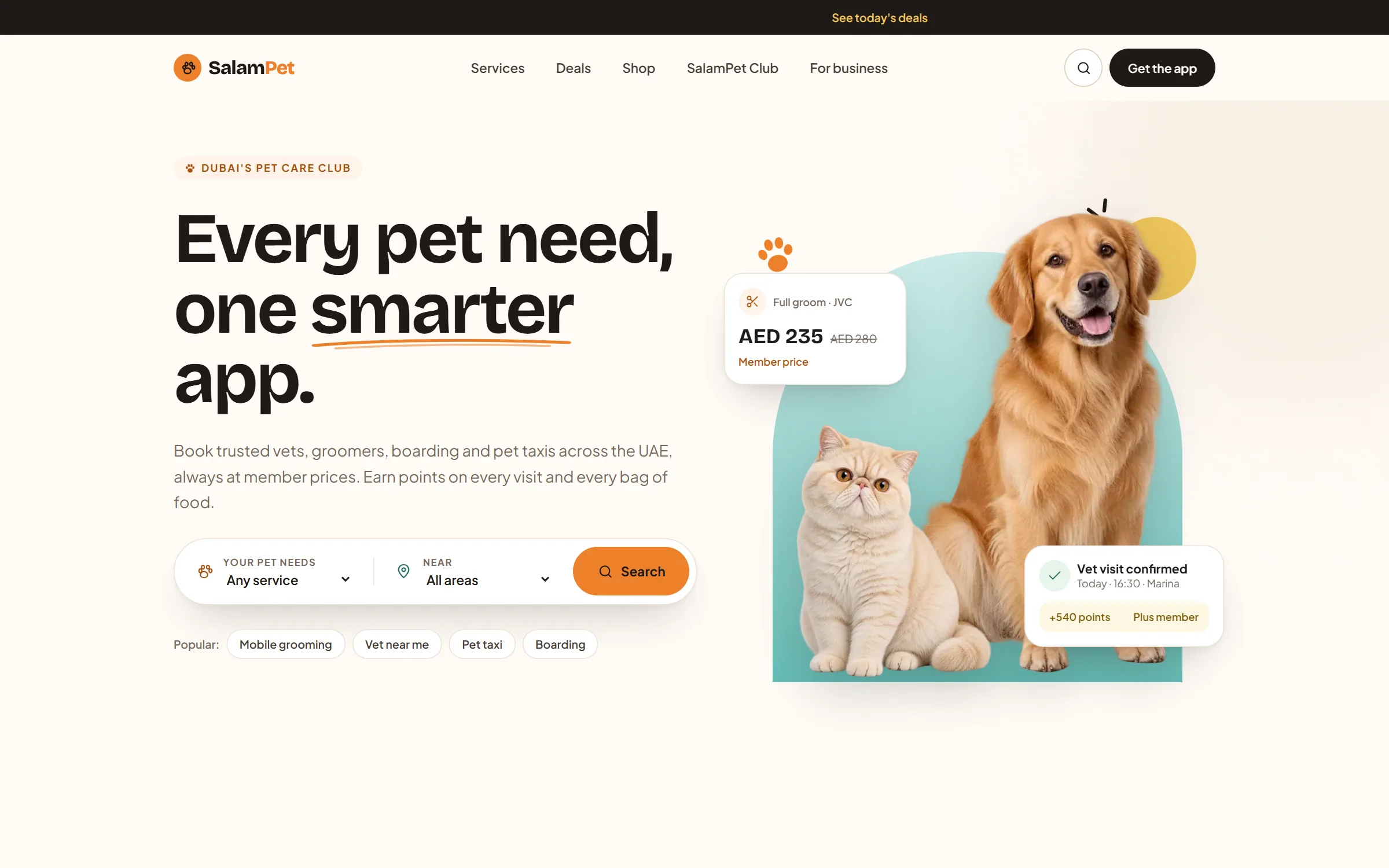
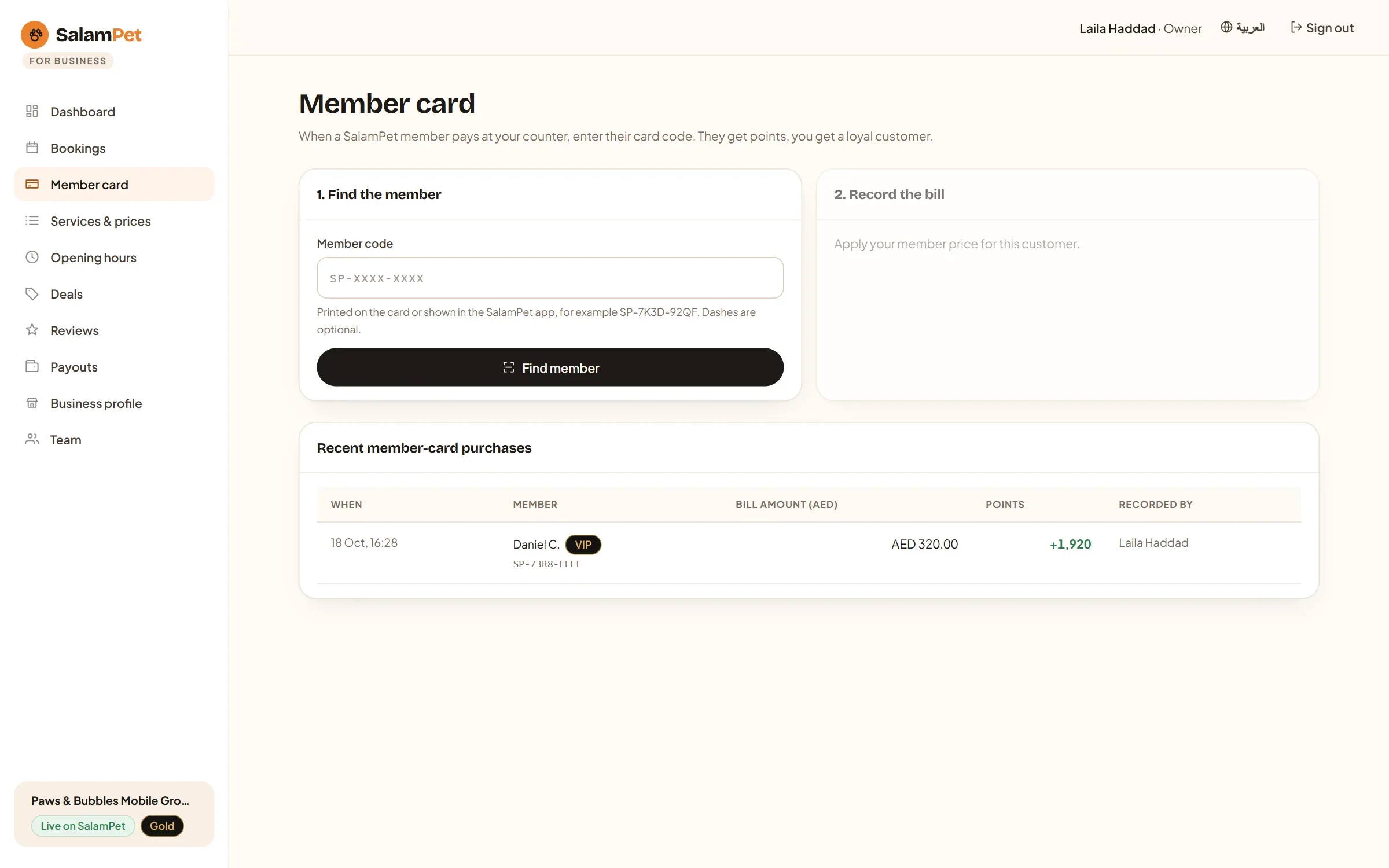
We started from a research pack and a blueprint in nine documents, among them the technical architecture and a specification of both panels, and built version 0.1 from them as one TypeScript codebase: a NestJS API over PostgreSQL and two Next.js panels that share one definition of roles, statuses and validation rules, and a customer website that shares the panels' design system. Every service a business lists takes one of eight booking modes, from a time slot or a night's stay to a visit to the customer, a quote or a ticket, the base on which the architecture means to add new kinds of care as settings rather than new code, and each service carries three prices: the business's regular price, a SalamPet price and a lower member price. A business signs up, adds its details, opening hours and services, uploads its trade licence and municipality registration to private storage and sends itself for review; the team approves it, rejects it with a reason or suspends it, and checks every deal before it goes live. At the counter, staff enter a member's card code, see the tier with the name shortened, record the bill, and the points go into a ledger that is only ever added to, never edited. Roles are defined once and enforced by the API, sign-in tokens stay in cookies that scripts in the browser cannot read, every sensitive action is written to an audit log, and a word filter in English, Arabic and Persian sees through Arabic and Persian letter variants, spaced-out words and Persian or Arabic digits, and always flags UAE phone numbers, links, email addresses, Emirates ID and IBAN numbers. The website is laid out in the look the founders chose, a warm cream canvas with cut-out pets on coloured arches, and we cleaned up the 20 pet cut-outs the founders supplied, with round face crops for eight of them, to fill it.
What we built
- A business panel and an admin panel on one API
- Every service set up with one of eight booking modes
- Three prices for every service: regular, SalamPet and member
- A member card that adds points when a member pays in store
- Licensed businesses only, checked by the team before going live
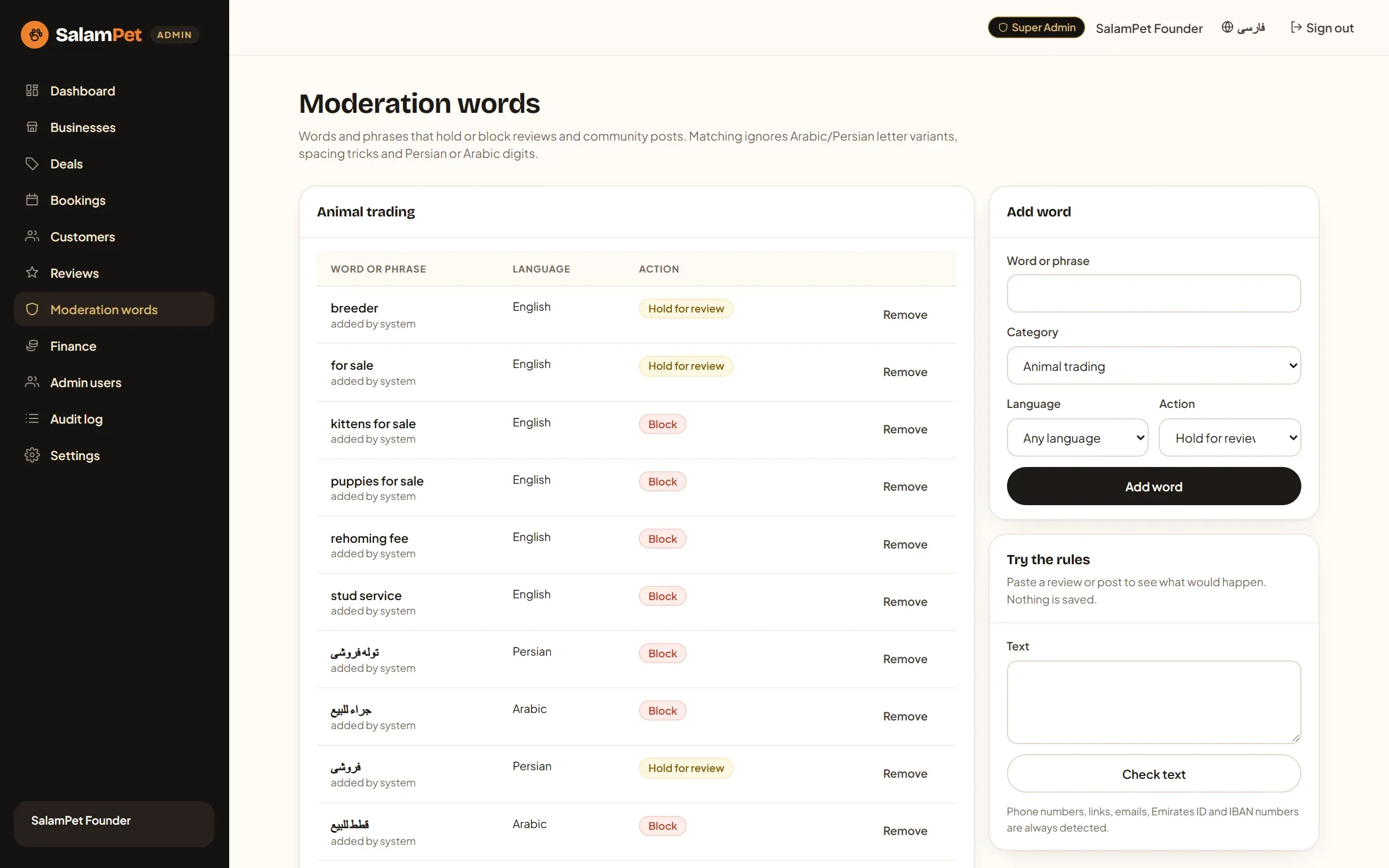
- A word filter in English, Arabic and Persian
The outcome
The website went online on 19 October 2026, and the API and both panels went into production the next day, with none of the demo data in them. The website has 19 pages: the home page, an overview of services, seven care categories, six business pages, deals, a shop page, the SalamPet Club and a page for businesses that leads to the business panel's sign-up. Behind sign-in, the two panels hold 29 screens, the business panel in English and Arabic and the admin panel in English and Persian, backed by 79 API routes and 21 database tables. Until real businesses join, the businesses, prices, deals and reviews on the website are sample content, so the site asks search engines not to index it. Next on the project's own list are the customer side of the API, connecting the website to it, a mobile app and payments, on the way to the pet super app its founders have in mind.
The parts of the system
The customer website
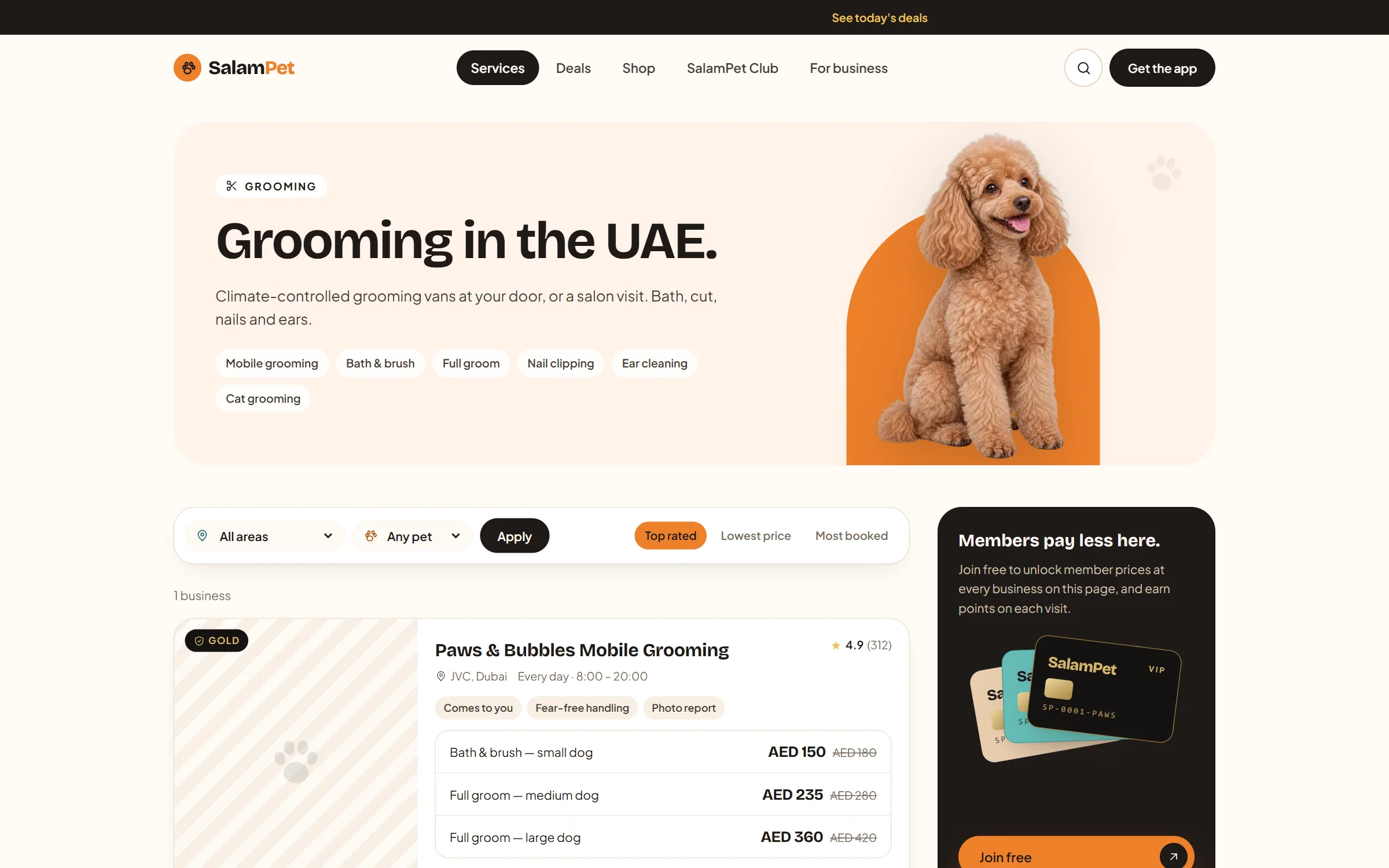
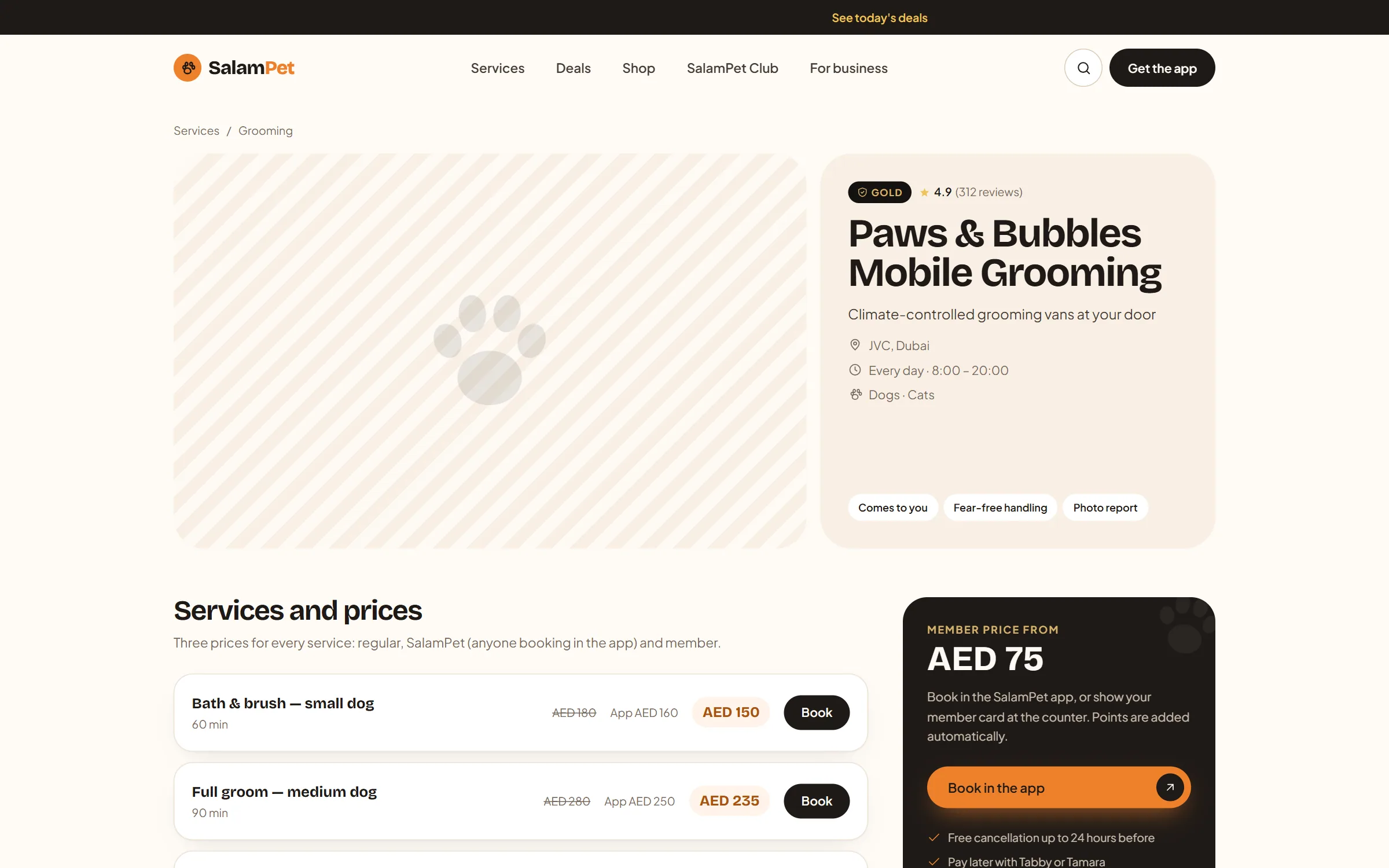
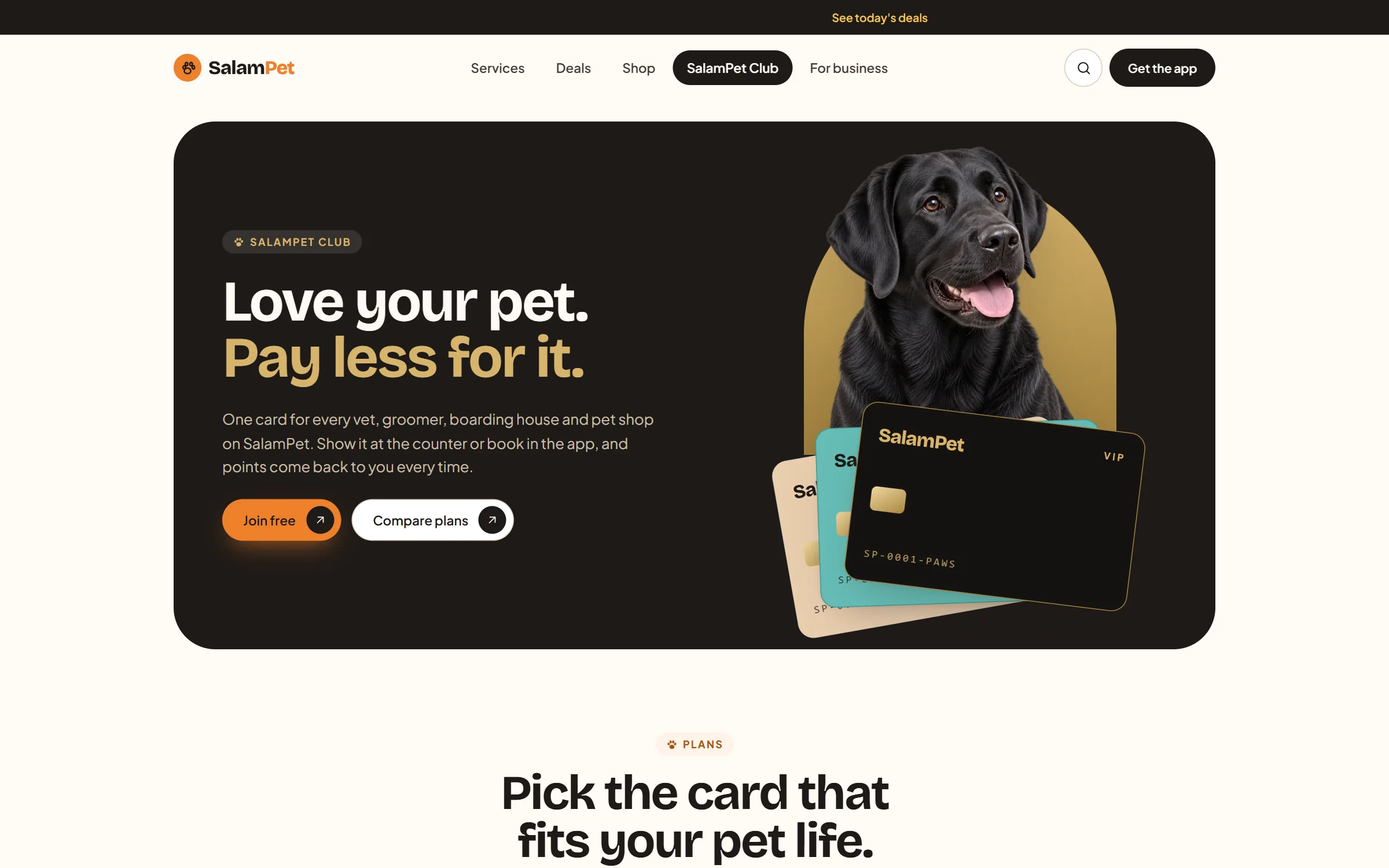
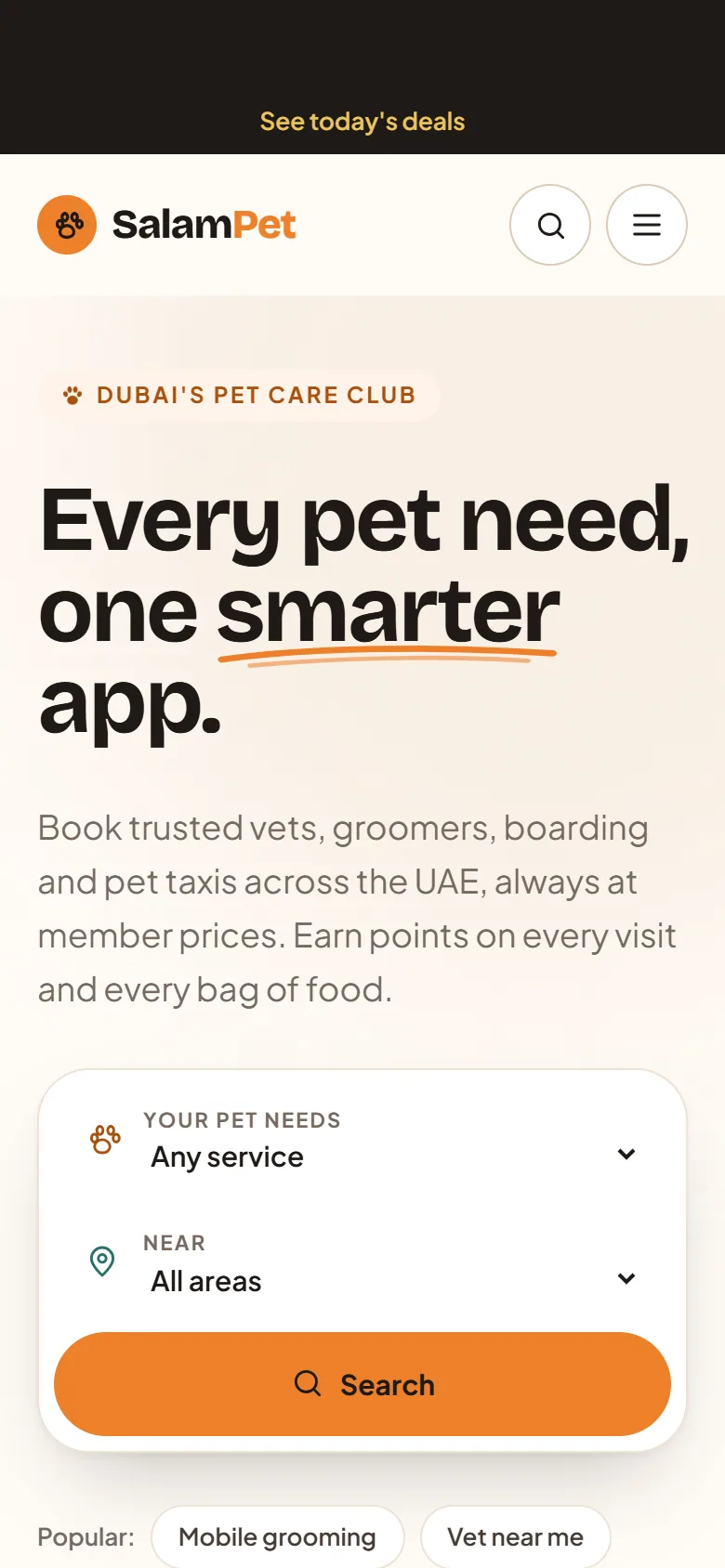
The site pet parents meet, in the look the founders chose: a search by care and area, seven categories that filter by area and pet and sort by rating, price or bookings, a page for each business with its services and three prices, deals, a shop page, the three-tier SalamPet Club and a page for businesses that leads to the panel's sign-up. Every image has a named slot, so a picture is replaced by adding a file with that name, without changing the code. Its businesses, prices and reviews are sample content until real businesses join and the website is connected to the API.
The business panel
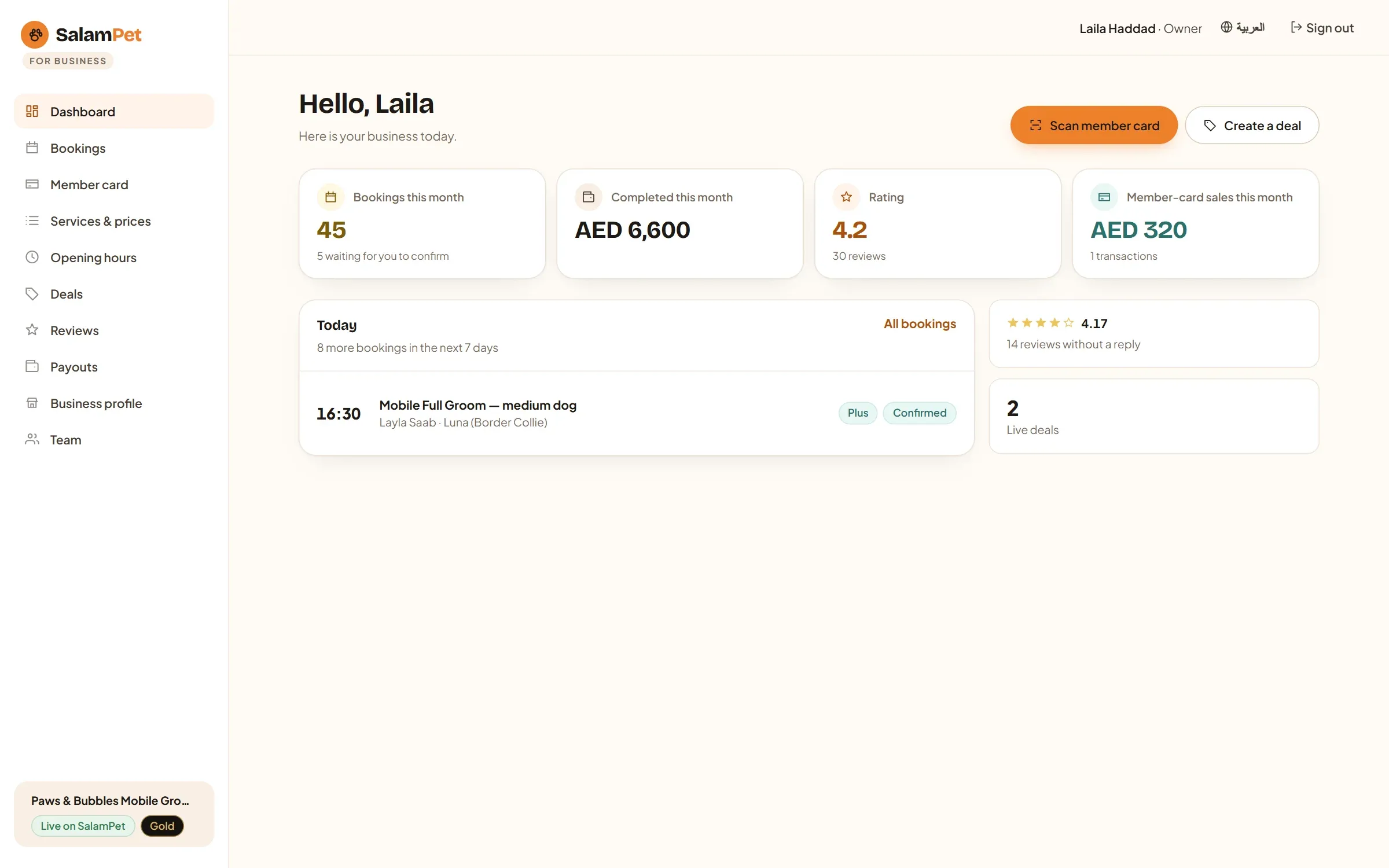
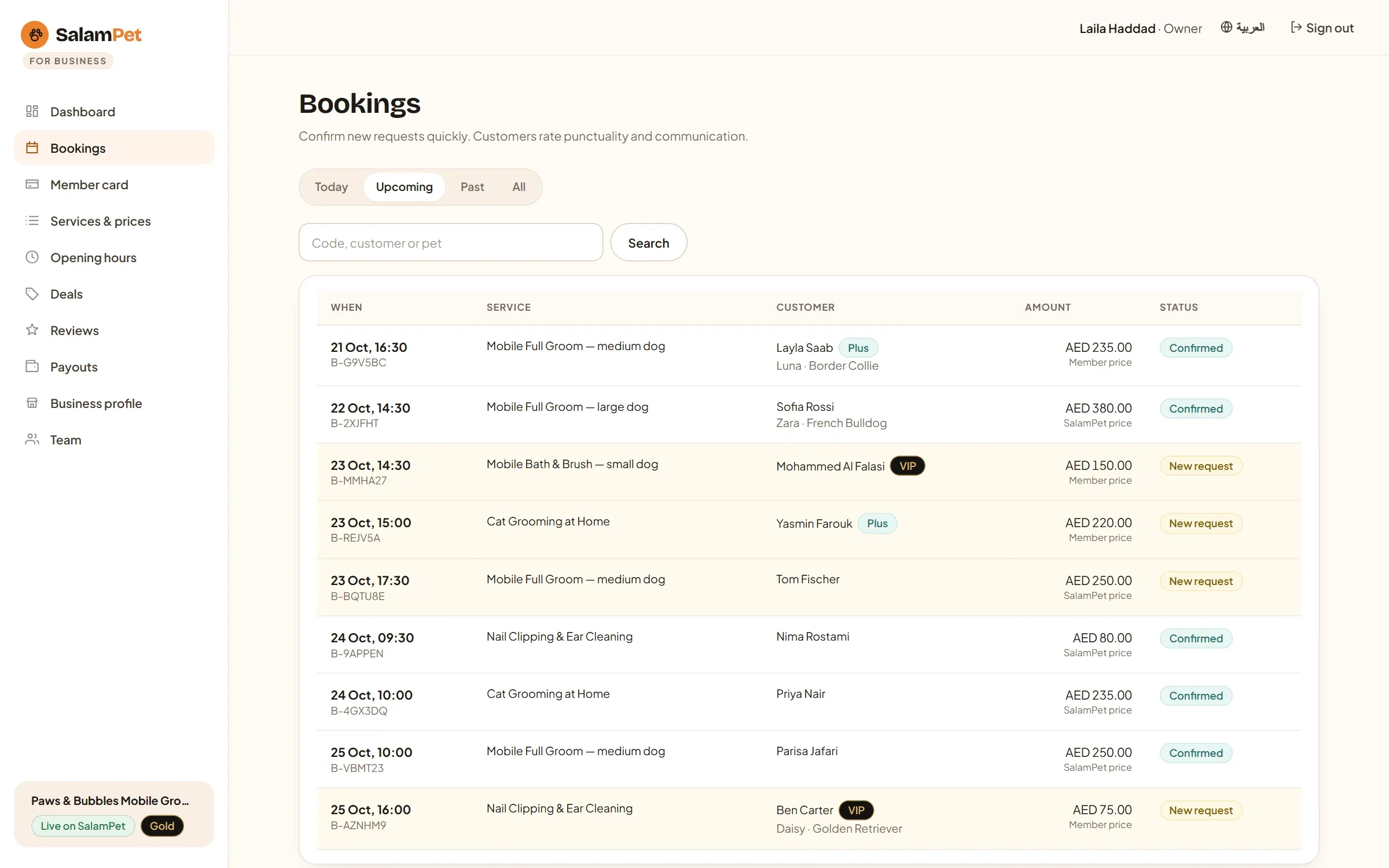
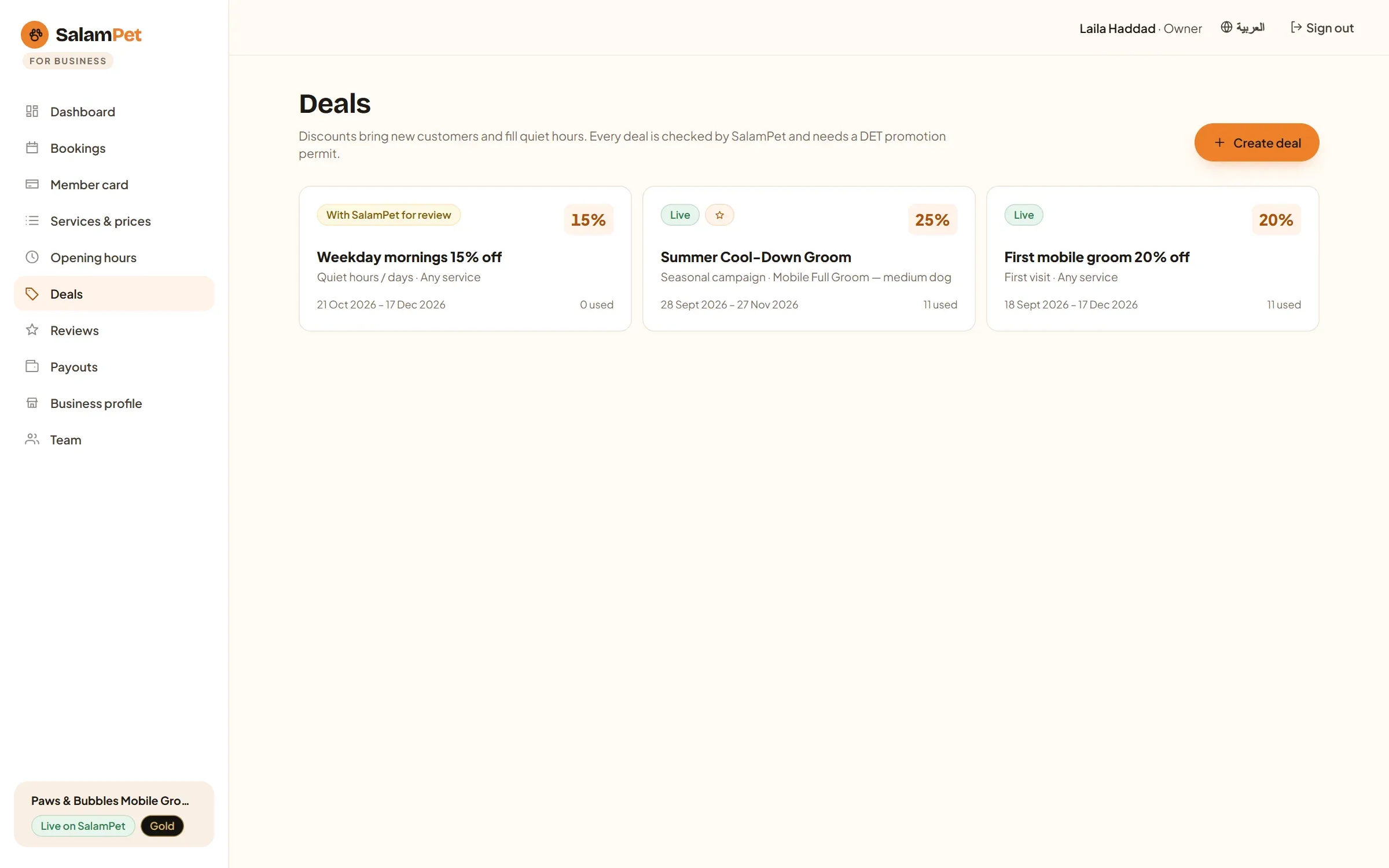
Where a pet business runs its side of SalamPet, in English or Arabic. A new business works through a checklist of licence details, documents, services and opening hours before it can send itself for review. Once it is live, its owner, managers and staff each sign in with their own role, which decides who can confirm bookings, set prices and deals, record member-card sales at the counter, reply to reviews or read payout statements. A customer's full phone number never reaches the business. The pictures below come from a local run with fictional demo data.
The admin panel
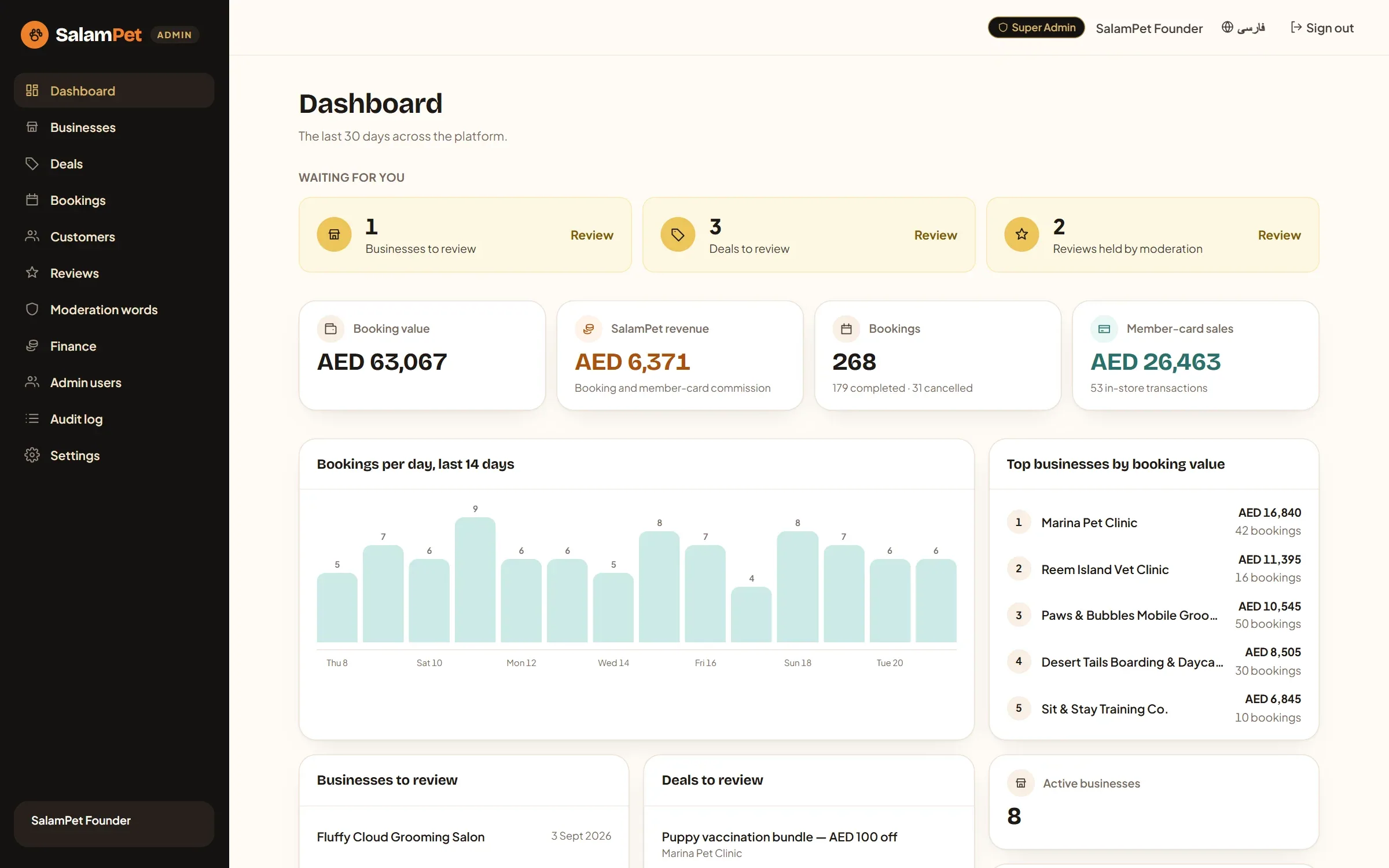
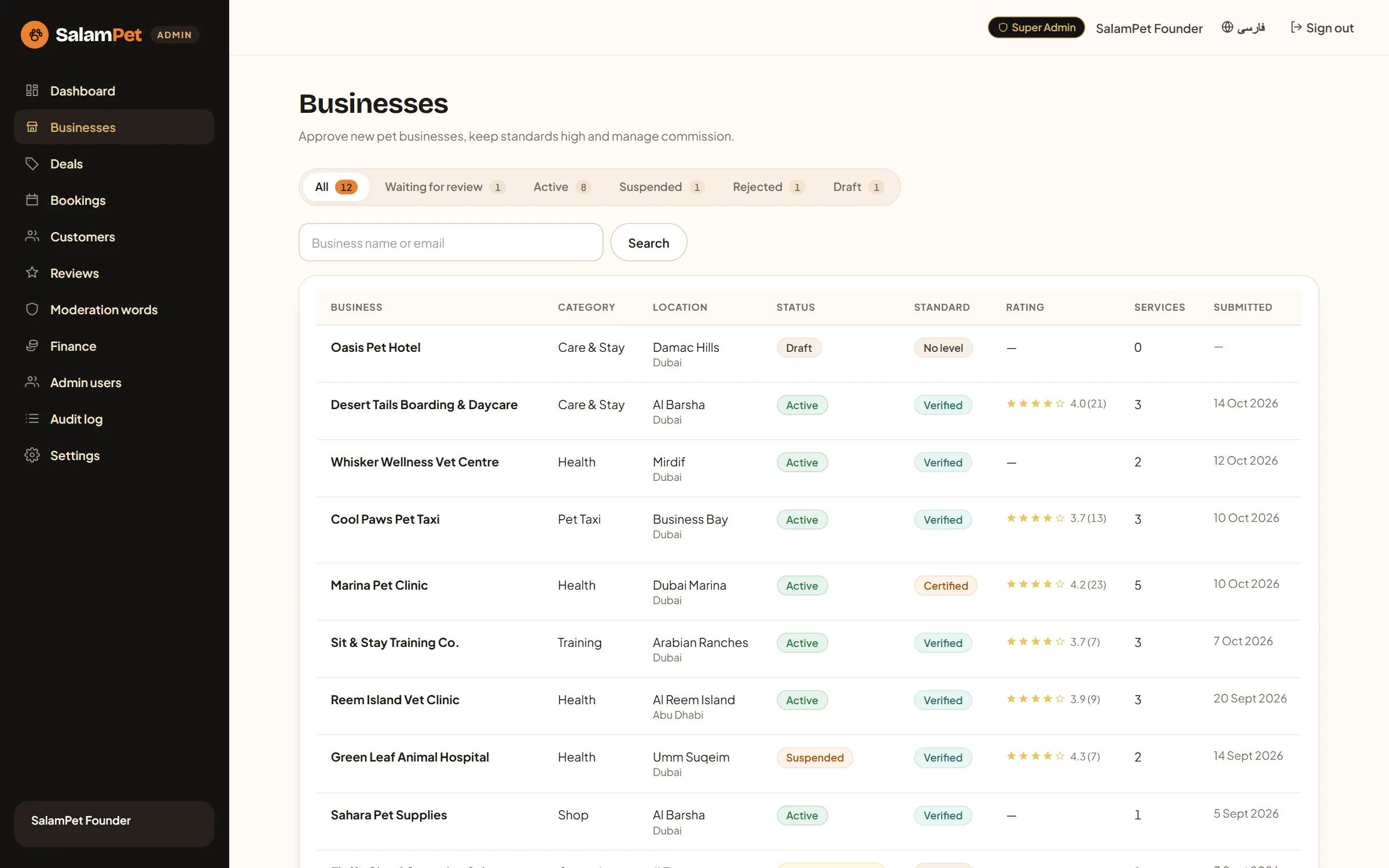
Where the SalamPet team looks after the platform, in English or Persian, with two levels of access. Admins review businesses, deals, bookings, customers and reviews; commission, points adjustments, moderation words, creating payout statements, admin accounts, the audit log and settings are kept for Super Admins. The API enforces the same rules, so a hidden button is never the only lock. The pictures below come from a local run with fictional demo data.
Have something similar in mind?
Send us the brief. We'll tell you honestly whether we're the right studio for it.
No pitch decks until we understand the problem.
hello@4ai.ae