Nano Banana
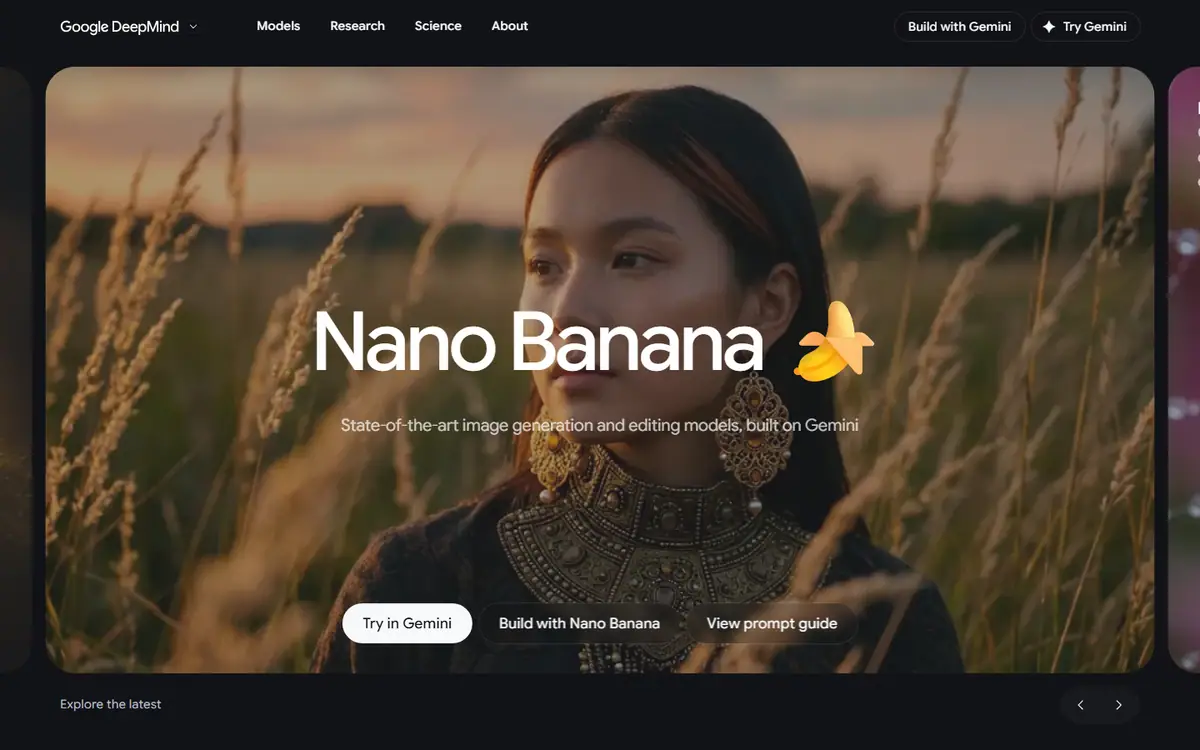
Nano Banana: image creation and conversational editing, with several reference images at once.
FrontierGoogle
In short
A useful evaluation candidate when a brief combines references, written instructions and several rounds of revision. Give each reference a separate role, such as product, lighting or composition. Test whether a later change preserves the decisions already approved.
What it can do
- Image creation and conversational editing
- Multiple reference images
- Search grounding
- Configurable thinking
Limits to plan for
- Grounding does not make generated visual claims automatically accurate.
- Model/account/product feature availability should be rechecked.
When a brief contains several references, the useful question is how clearly each one can guide the result. Google's Nano Banana 2.1 image model supports conversational creation and editing with multiple references; its documented options also include search grounding and configurable thinking.
Give every reference a job
Label one image as the product, another as lighting guidance and a third as a composition example. Identify which details may change and which must survive every revision. This turns a broad mood board into a brief that can be assessed.
Use the first test to establish the subject and layout. Request one meaningful change at a time, then compare the new image with the last approved version. A later edit should not quietly alter a label, remove an object or change the scale relationship between products.
Check facts outside the image
Search grounding is a production aid, not verification of a generated visual claim. Confirm real places, product details and written statements against reliable source material. Proofread every language separately and inspect the final crop rather than relying on a full-size preview.
The documented route is the Gemini API with linked Google AI Studio access; account and product availability still need checking. For a campaign with several references and language versions, discuss the artwork brief with 4AI before deciding the production scope.
Sources checked 27 October 2026: Google Nano Banana 2.1 model.
Before you commit
Compare text, objects and composition after every edit; verify any real-world detail independently.
Compare it with
Other models in the same category, nearest tier first.
 Frontier
GPT Image
OpenAIGPT Image 2.5 Sunburst / GPT Image 2.5 Flare
Creates images from text and makes precise follow-up edits with reference images.
Read the profile Frontier
Midjourney
MidjourneyMidjourney V8.2 / Edit Model
An art director's sketchbook: style references and personalization for finding a campaign's look.
Read the profile Pro
FLUX.2
Black Forest LabsFLUX.2 [max], [pro], [flex], [klein] and [dev]
A model family that runs from a hosted API to open weights, with multi-reference generation and editing.
Read the profile
Where we use it
Read next
- Choosing an AI image model for brand work: a practical buyer's guideHow to choose an AI image workflow for brand work by testing reference fidelity, revision control, typography and delivery against a real brief, with the options checked on 27 October 2026.
- AI product imagery: what to generate, preserve and check before publishingA practical workflow for product images that combines approved source assets, generated settings, controlled edits and a careful final review, with provider capabilities checked on 27 October 2026.
- Keeping characters and products consistent across AI images and videoBuild a reference system, define what may change and review continuity across AI-generated campaign images and video, with reference controls checked on 27 October 2026.
Choosing tools for a real brief?
Tell us what you need to make, launch or improve. We scope the work first, then choose the tools around it.
No pitch decks until we understand the problem.
hello@4ai.ae